Why Ice Dropped 137 Meters Sounds Like a Laser
Why Ice Dropped 137 Meters Sounds Like a Laser
If you drop a chunk of ice down a 137-meter-deep hole, you probably expect to hear a distant thud, crack, or splash when it reaches the bottom.
What you probably don’t expect is something that sounds like it came straight out of Star Wars.
Yet that’s exactly what can happen.
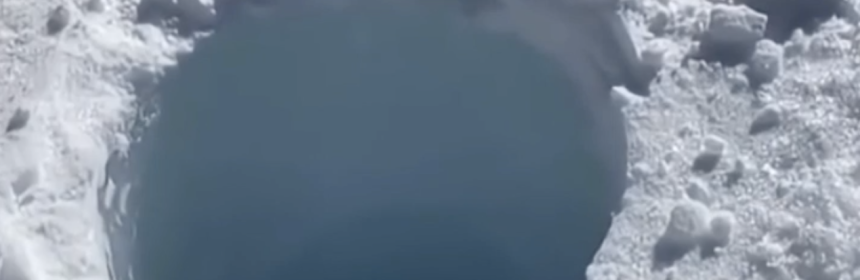
Videos of people dropping ice into extremely deep holes in glaciers and ice sheets have fascinated the internet because of the bizarre sound that follows. After several seconds of silence, the ice reaches the bottom—and suddenly the hole erupts with an eerie, high-pitched “PEW!”
It sounds remarkably like a laser gun.
But there’s no science-fiction technology involved. The explanation is actually a fascinating combination of gravity, acoustics, echoes, and the shape of the hole itself.
The Long Fall
A depth of 137 meters is approximately 450 feet—roughly the height of a 40-story building.
Once released, the ice accelerates downward because of gravity. Air resistance and collisions with the walls can affect its speed, but the ice still has plenty of time to accelerate before reaching the bottom.
When it finally strikes, the impact produces a sharp burst of sound.
That’s when things get interesting.
The sound has to travel all the way back up the same narrow hole.
The Hole Becomes a Giant Musical Instrument
A deep borehole isn’t simply an empty tunnel.
Acoustically, it behaves somewhat like an enormous pipe.
When the ice hits the bottom, the impact produces many different sound frequencies at once. Those sound waves begin traveling upward through the narrow column of air.
But different frequencies don’t necessarily behave identically inside the hole.
Some frequencies are reinforced by the shape and dimensions of the borehole, while others are weakened. Sound also reflects repeatedly from the walls as it travels upward.
The result is a strange acoustic filtering effect.
Instead of hearing a simple CRACK, someone standing at the surface can hear a rapidly changing series of frequencies.
To our ears, that changing pitch sounds remarkably like:
PEEEEOOOW!
In other words, a laser.
Why Does the Pitch Change?
One of the coolest parts of the effect is that the sound often seems to slide from a higher pitch toward a lower one.
That isn’t because the ice suddenly turns into a laser gun.
It’s because the sound produced by the impact contains a broad range of frequencies, and those frequencies can propagate through the borehole differently.
The cylindrical hole effectively acts as an acoustic waveguide.
Higher-frequency components and lower-frequency components can reach the listener at slightly different times. Although those differences may be tiny, our ears are extremely good at detecting changes in pitch.
Stretch those differences across a deep enough hole and the result becomes surprisingly noticeable.
The descending pitch creates the classic science-fiction laser effect.
There’s Also an Echo
The depth of the hole makes the phenomenon even more dramatic.
Sound travels through ordinary air at roughly 343 meters per second, depending on temperature and atmospheric conditions.
For a 137-meter hole, sound produced at the bottom takes roughly:
137 ÷ 343 ≈ 0.4 seconds
just to travel back to the surface.
And that’s after waiting for the ice itself to fall.
Reflections inside the hole can then produce additional echoes and resonances, making the sound seem longer and stranger than the original impact.
Essentially, you’re hearing the hole itself modify the sound.
Scientists Actually Use These Holes
Deep holes in glaciers aren’t normally drilled so people can throw ice into them for entertainment.
Researchers drill boreholes into glaciers and ice sheets for a variety of scientific purposes. Instruments can be lowered into them to measure temperature, movement, pressure and other properties of the ice.
Some holes extend hundreds or even thousands of meters beneath the surface.
Dropping something into one simply happens to reveal a spectacular acoustic side effect.
Nature Accidentally Invented a Laser Sound Effect
Perhaps the best part is that the famous “laser” noise isn’t electronically generated.
There are no speakers.
No synthesizers.
No special effects.
Just a piece of ice, gravity, air and an extremely deep hole.
The ice creates the initial impact, but the borehole transforms that ordinary noise into something extraordinary. Its unusual acoustics separate, reflect and reshape the frequencies until they arrive at the surface as the unmistakable descending whistle.
So the next time you hear a video of ice being dropped 137 meters into a glacier and think:
“That sounds exactly like a laser!”
You’re not imagining it.
You’re essentially listening to a 450-foot-long natural sound-effects machine—one powered entirely by physics.